
Introduction

Every Tarot card carries a wealth of symbolism and wisdom, yet scholars and occultists remain divided on exactly where they came from. Are they the distilled wisdom of ancient Egyptian priests? A divinatory tool used by the Romani people during their nomadic travels? Or a visual representation of the Jewish Kabbalistic Tree of Life? Today, rather than claiming absolute authority, we explore these widely circulated and intriguing origin stories with an open mind.
Ancient Egyptian Origin: The Legend of the Book of Thoth

This is one of the most romanticized origin theories. In the 19th century, the occultist Eliphas Lévi proposed that Tarot cards originated from the ancient Egyptian Book of Thoth. Legend has it that Thoth, the god of wisdom, inscribed the mysteries of the universe onto 22 golden plates. These images were eventually preserved and evolved into the Major Arcana of the Tarot. Although there is no archaeological evidence to support this, the correspondence between the 22 Major Arcana cards, the 22 Egyptian hieroglyphs, and the 22 stages of initiation has kept this theory popular within occult circles. Egyptian elements retained in the Waite-Smith Tarot and the Minor Arcana (such as the pomegranates and palms behind the High Priestess) also reinforce this association.
Gypsy Transmission Theory: The Secret Language of Nomads

Another common theory suggests that Tarot cards were brought to Europe from the East by the Gypsies (Romani people). When Tarot cards first appeared in Italy in the 15th century, it coincided with large-scale Romani migrations into Europe. As they earned a living through divination, the cards they carried were naturally viewed as mystical tools. However, historians point out that the earliest recorded Tarot cards were the "Tarocchi" used by Italian nobility for a card game, rather than being exclusive to the Romani. Nevertheless, the Romani people certainly imbued the Tarot with a strong divinatory character during its dissemination, transforming it from an entertainment tool into a medium for spiritual connection.
Jewish Kabbalah Theory: A Reflection of the Tree of Life
Enthusiasts interested in profound philosophy often favor the Kabbalistic origin theory. The 22 cards of the Major Arcana correspond exactly to the 22 letters of the Hebrew alphabet, while the 10 Sephiroth on the Kabbalistic Tree of Life and the Four Worlds align strikingly with the numbering and elemental systems of the Minor Arcana. Occultists believe that the Tarot is essentially a "visualized Kabbalah"—a way to teach the process of universal creation and the path of the soul's cultivation through imagery. This theory was systematically articulated in the writings of the Hermetic Order of the Golden Dawn and has profoundly influenced almost every Tarot system that followed.
Medieval European Card Theory: A Pragmatic Historical Interpretation
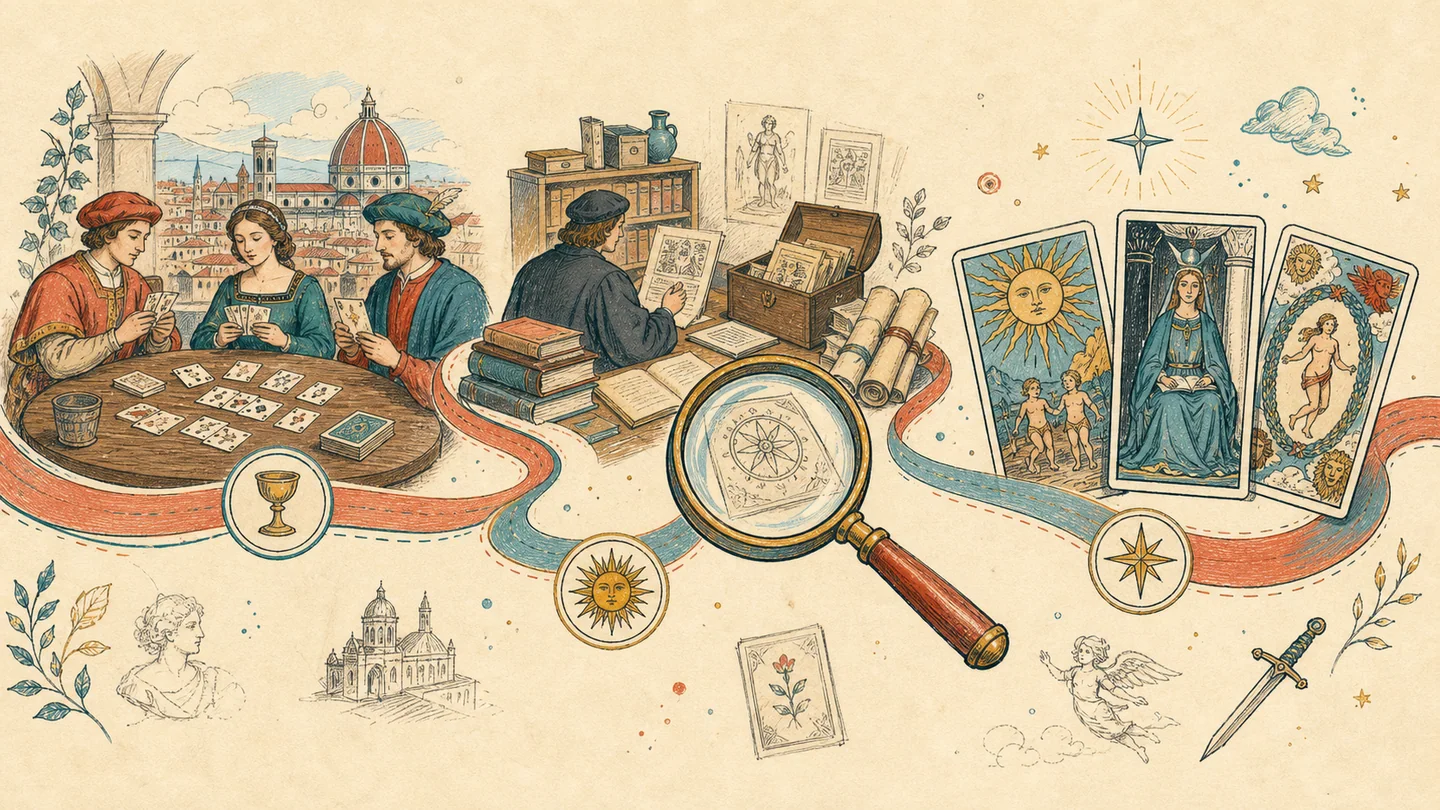
Contrasting with occult theories is the perspective of the historical school. According to surviving documents, the earliest Tarot cards appeared in the courts of Northern Italy in the 15th century, used for an aristocratic game called "Trionfi" (Triumphs). These cards depicted allegorical figures such as the Pope, the Emperor, the Lovers, and Death, which were consistent with the moral allegories found in European art of the time. Historians believe the 22 cards of the Major Arcana are a microcosm of medieval social hierarchy and religious concepts, while the Minor Arcana derived directly from standard playing cards (totaling 56 cards). While this explanation lacks mystical allure, it is supported by solid archival evidence.
Fusion and Inspiration: The Charm of Having No Single Answer
In reality, each of the above theories contains a kernel of truth as well as logical gaps. The true origin of the Tarot is likely a process of multi-source fusion: it absorbed ancient Egyptian symbols, Kabbalistic philosophy, and the visual traditions of medieval Europe, constantly morphing within the cultural soil of different eras. Perhaps, as some occultists say, "The origin is not important; what matters is how it works in the present." The moment each card is turned over in your hand, a brand-new history is created.
Conclusion
The charm of Tarot does not lie in finding the one correct answer, but in its ability to allow us to embrace multiple possibilities simultaneously. The next time you lay out a spread, you might silently reflect on these ancient legends: each card carries the moonlight of ancient Egypt, the dust of Romani travels, the divine thoughts of the Kabbalah, and the candlelight of European courts. This, perhaps, is the most moving secret of the Tarot.