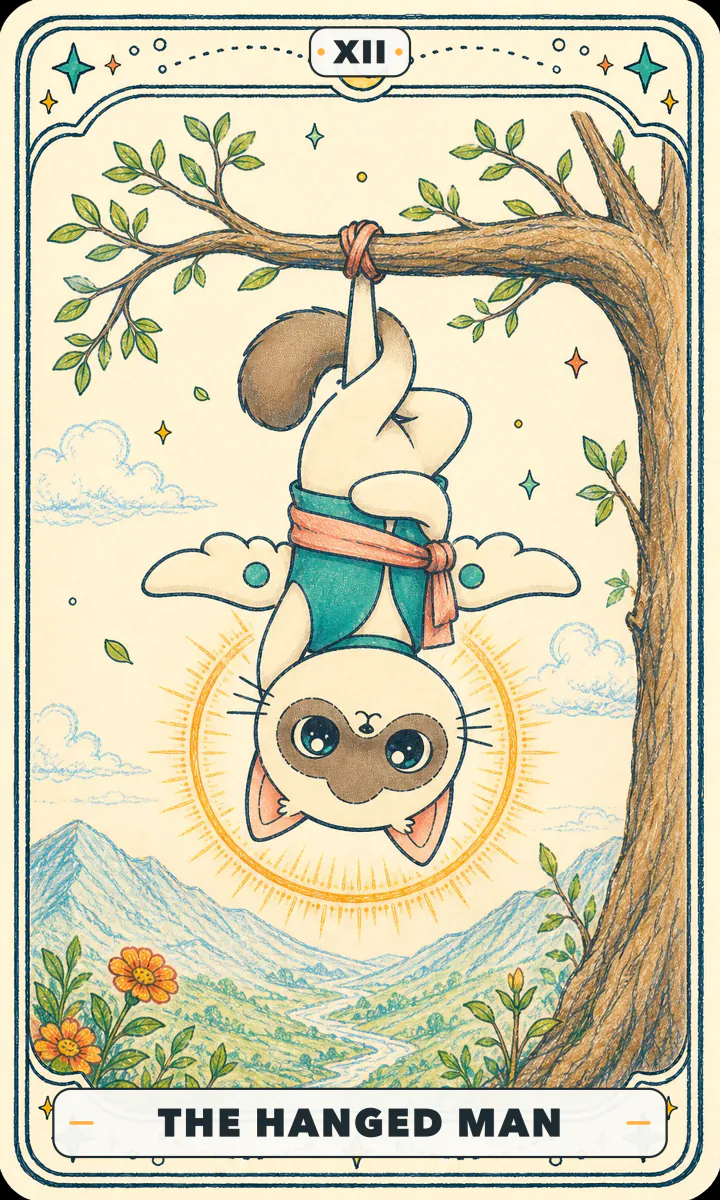
The Hanged Man
Sacrifice, New Perspective
Quick answer
The core meaning of The Hanged Man is Seeing the world from another angle. Upright, it usually points to Sacrifice, a new perspective, suspension, letting go. Symbolizes gaining higher; reversed, it may suggest Needless sacrifice, delay, stalemate, struggling. May indicate suffering for the.
Card imagery
A man hangs upside down by one foot from a T-shaped tree, his legs forming the shape of a 4. A halo glows around his head, and his expression is serene rather than pained. He wears a blue tunic and red leggings.
Upright meaning
Sacrifice, a new perspective, suspension, letting go. Symbolizes gaining higher wisdom and a completely new view of the world through deliberate stillness or the surrender of the ego.
Reversed meaning
Needless sacrifice, delay, stalemate, struggling. May indicate suffering for the wrong reasons, or being unable to break free of some bondage.
Love, Career, Money, and Growth
Love
In love, The Hanged Man points to Seeing the world from another angle. Read it back against how the relationship actually behaves and what you are both choosing.
Career
In career matters, The Hanged Man points to Seeing the world from another angle. Start by working out which resources you control and what your next move is.
Money
In money matters, The Hanged Man points to Seeing the world from another angle. Do not treat a symbolic reading as an investment conclusion — go by facts, budget and your own risk tolerance.
Personal growth
For personal growth, The Hanged Man points to Seeing the world from another angle. Write down the question it raises, then turn that into an action you can actually check.
How they feel
When The Hanged Man shows how someone feels about you, the theme of their attitude is: Seeing the world from another angle. Upright, that feeling is turned outward and easy to see; reversed, it stays inside them for now. Don't treat it as a verdict: check it against how they actually act.
Yes or No
Upright
Maybe
Reversed
No
This is our own quick read, based on which way the card’s meaning leans. Traditions disagree about individual cards, and a “Maybe” needs to be weighed against the position in the spread and your actual situation rather than taken as a one-word answer.
Waite’s Original Text (1911)
Inner Symbolism (original)
The gallows from which he is suspended forms a Tau cross, while the figure—from the position of the legs—forms a fylfot cross. There is a nimbus about the head of the seeming martyr. It should be noted (1) that the tree of sacrifice is living wood, with leaves thereon; (2) that the face expresses deep entrancement, not suffering; (3) that the figure, as a whole, suggests life in suspension, but life and not death. It is a card of profound significance, but all the significance is veiled. One of his editors suggests that Eliphas Lévi did not know the meaning, which is unquestionable—nor did the editor himself. It has been called falsely a card of martyrdom, a card of prudence, a card of the Great Work, a card of duty; but we may exhaust all published interpretations and find only vanity. I will say very simply on my own part that it expresses the relation, in one of its aspects, between the Divine and the Universe.
He who can understand that the story of his higher nature is imbedded in this symbolism will receive intimations concerning a great awakening that is possible, and will know that after the sacred Mystery Of Death there is a glorious Mystery Of Resurrection.
Original Upright Meaning
Wisdom, circumspection, discernment, trials, sacrifice, intuition, divination, prophecy.
Original Reversed Meaning
Selfishness, the crowd, body politic.
Quoted from A. E. Waite, The Pictorial Key to the Tarot (1911), illustrated by Pamela Colman Smith. The text is in the public domain.
Myth and symbol origins
The image is a medieval Italian punishment for traitors. Odin was attached to it much later.
Documented imagery
Attested by surviving objects or texts
Shame paintings: hanging upside down was a punishment
Medieval Italy had a public penalty called pittura infamante: the likeness of a traitor, defaulting debtor or political enemy was painted hanging by one foot on the outside wall of a public building for everyone to see. In early Italian decks this card is L'Appeso, the hanged one, and it also appears as Il Traditore, the traitor. To a fifteenth-century viewer, in other words, the first reading of this card was "this man has been sentenced," not "this man is meditating."
Source The medieval Italian pittura infamante; early Italian card names L'Appeso / Il Traditore
Esoteric correspondence
A sourced traditional claim, but constructed inside an occult system
Waite crossed out the martyrdom reading himself
Waite rejects the popular readings one by one: the card, he writes, "has been called falsely a card of martyrdom, a card of prudence, a card of the Great Work, a card of duty." He asks the reader to note three things — the tree of sacrifice is living wood with leaves on it; the face expresses deep entrancement, not suffering; and the figure as a whole suggests "life in suspension, but life and not death." His own reading is a relation between the Divine and the Universe. The gallows forms a Tau cross, and the crossed legs what he calls a fylfot cross.
Source Waite, The Pictorial Key to the Tarot, 1911, The Hanged Man (compare the original in the source panel on this page)
The element of water and the letter Mem
The Golden Dawn assigns the Hanged Man to the element of water and the Hebrew letter Mem, which literally means water. Suspension, letting go, going with the current — that whole register comes from here rather than from any planet. Three trumps (the Fool, the Hanged Man, Judgement) take the three elemental letters in this system instead of planetary attributions.
Source Golden Dawn Book T elemental letter attributions
Modern reading
Popular only since the twentieth century; unrelated to where the card came from
Odin's sacrifice: useful, as long as you know it was attached
The most popular modern reading connects this card to Norse myth: Odin hangs himself on the world tree for nine nights, wounded by a spear, sacrificed to himself, and takes up the runes at the end of it. The passage is real (Hávamál 138–139). Two things to keep straight, though. First, the text says he hung "on a windy tree nine long nights" and never says upside down; the inversion is later readers fitting the text to the picture. Second, the passage has no historical connection to tarot at all — the distance in time and place is far too great. As a memory hook it works well. Just do not teach it as where the card came from.
Source Modern popular reading; Odin's self-sacrifice is in the Hávamál 138–139
Written by BESTAROT, not quoted from historical sources. Each claim is tagged by how well it is evidenced; modern interpretive layers are useful for reading, but they are not the card’s historical origin.
Study the theme: Myth and Symbol Origins (Academy chapter 6)