Justice
Fairness, Truth
Quick answer
The core meaning of Justice is The objective balance of cause and effect. Upright, it usually points to Justice, truth, cause and effect, the law. Symbolizes objective assessment and f; reversed, it may suggest Injustice, bias, avoiding accountability, legal disputes. May indicate being tre.
Card imagery
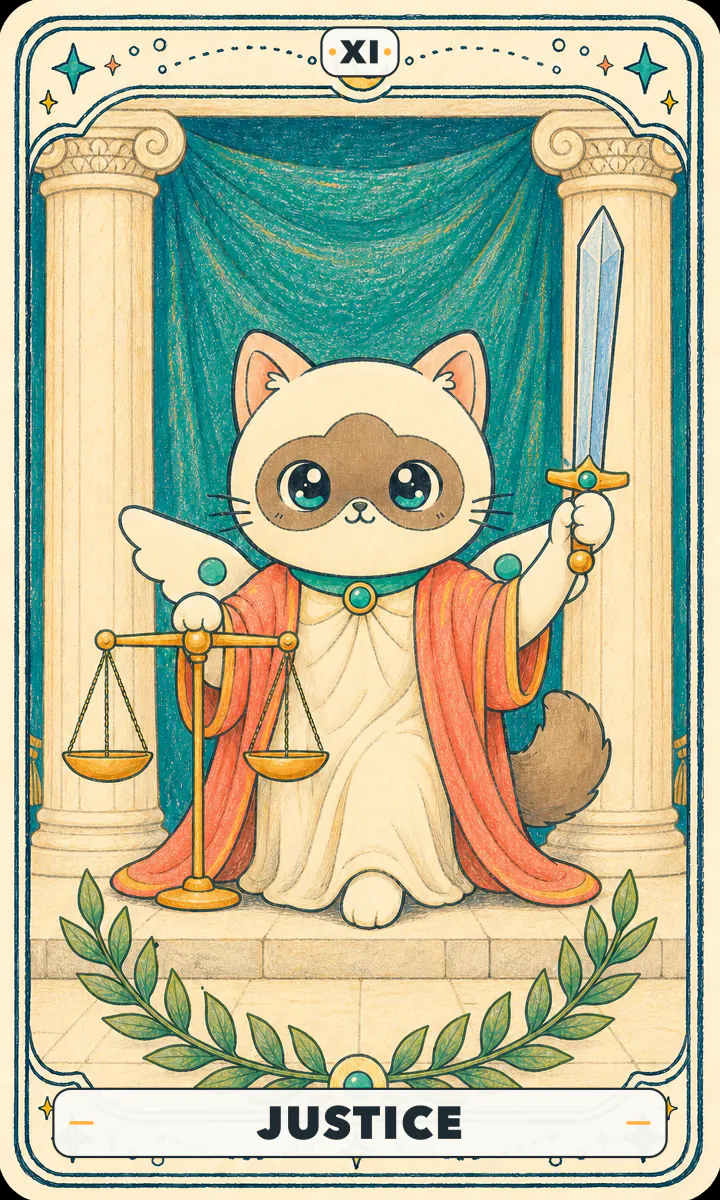
A stern woman sits between two stone pillars before a purple veil. Her right hand raises a sword (reason) while her left holds a set of scales (balance). One exposed foot symbolizes action.
Upright meaning
Justice, truth, cause and effect, the law. Symbolizes objective assessment and fact-based decisions, underscoring the law of karma: you reap what you sow.
Reversed meaning
Injustice, bias, avoiding accountability, legal disputes. May indicate being treated unfairly, or deceiving yourself and refusing to face the truth.
Love, Career, Money, and Growth
Love
In love, Justice points to The objective balance of cause and effect. Read it back against how the relationship actually behaves and what you are both choosing.
Career
In career matters, Justice points to The objective balance of cause and effect. Start by working out which resources you control and what your next move is.
Money
In money matters, Justice points to The objective balance of cause and effect. Do not treat a symbolic reading as an investment conclusion — go by facts, budget and your own risk tolerance.
Personal growth
For personal growth, Justice points to The objective balance of cause and effect. Write down the question it raises, then turn that into an action you can actually check.
How they feel
When Justice shows how someone feels about you, the theme of their attitude is: The objective balance of cause and effect. Upright, that feeling is turned outward and easy to see; reversed, it stays inside them for now. Don't treat it as a verdict: check it against how they actually act.
Yes or No
Upright
Maybe
Reversed
No
This is our own quick read, based on which way the card’s meaning leans. Traditions disagree about individual cards, and a “Maybe” needs to be weighed against the position in the spread and your actual situation rather than taken as a one-word answer.
Waite’s Original Text (1911)
Inner Symbolism (original)
As this card follows the traditional symbolism and carries above all its obvious meanings, there is little to say regarding it outside the few considerations collected in the first part, to which the reader is referred.
It will be seen, however, that the figure is seated between pillars, like the High Priestess, and on this account it seems desirable to indicate that the moral principle which deals unto every man according to his works—while, of course, it is in strict analogy with higher things—differs in its essence from the spiritual justice which is involved in the idea of election. The latter belongs to a mysterious order of Providence, in virtue of which it is possible for certain men to conceive the idea of dedication to the highest things. The operation of this is like the breathing of the Spirit where it wills, and we have no canon of criticism or ground of explanation concerning it. It is analogous to the possession of the fairy gifts and the high gifts and the gracious gifts of the poet: we have them or have not, and their presence is as much a mystery as their absence. The law of Justice is not, however, involved by either alternative. In conclusion, the pillars of Justice open into one world and the pillars of the High Priestess into another.
Original Upright Meaning
Equity, rightness, probity, executive; triumph of the deserving side in law.
Original Reversed Meaning
Law in all its departments, legal complications, bigotry, bias, excessive severity.
Quoted from A. E. Waite, The Pictorial Key to the Tarot (1911), illustrated by Pamela Colman Smith. The text is in the public domain.
Myth and symbol origins
The classical goddess of justice carries a sword and scales, but she is not blindfolded — the blindfold was added centuries later.
Documented imagery
Attested by surviving objects or texts
Justice among the cardinal virtues, on a classical scheme
Justice (Iustitia) is one of the four classical cardinal virtues, and along with Strength (Fortitude) and Temperance she holds a trump of her own in this deck. The personification with sword and scales is the fixed form since Rome: the scales weigh, the sword enforces. On the Greek side there are two figures — Themis governs divine law and order, Dike the just verdict among human beings; Rome gathered that whole line into Iustitia.
Source The classical four cardinal virtues; the classical iconography and remits of Iustitia / Themis / Dike
She is not blindfolded, and that matters
The Justice standing outside a courthouse today is usually blindfolded, but that addition only became common after the sixteenth century, and it began with a satirical edge (the implication being that the judge cannot see). The Justice of the tarot has her eyes open and looks straight at the person reading. So the card is not about refusing to look in the name of impartiality; it is about seeing clearly and then weighing — the two schemes differ by one gesture, and the meanings end up far apart.
Source The blindfolded Justice is a post-sixteenth-century development in the imagery; the tarot Justice is not blindfolded
Esoteric correspondence
A sourced traditional claim, but constructed inside an occult system
She sits between two pillars too, but they open elsewhere
Waite notes that the figure is "seated between pillars, like the High Priestess," and takes care to draw the line: Justice deals with the moral principle of rendering to each according to his works, and is what "differs in its essence" from the spiritual justice of election that belongs to the High Priestess. His conclusion is a single sentence: "the pillars of Justice open into one world and the pillars of the High Priestess into another." The Golden Dawn attribution is Libra (Hebrew letter Lamed).
Source Waite, The Pictorial Key to the Tarot, 1911, Justice; Golden Dawn Book T zodiacal attributions
Modern reading
Popular only since the twentieth century; unrelated to where the card came from
"Karmic settling of accounts" was moved in later
Reading Justice as karma and cosmic retribution is the same merchandise as the "wheel of karma" on the Wheel of Fortune: the fusion that followed the late-nineteenth-century Theosophical import of Indian ideas of karma into Western esotericism. The classical goddess weighs and judges the case in front of her. Settling accounts across lifetimes is not her business.
Source Modern popular reading, no historical basis
Written by BESTAROT, not quoted from historical sources. Each claim is tagged by how well it is evidenced; modern interpretive layers are useful for reading, but they are not the card’s historical origin.
Study the theme: Myth and Symbol Origins (Academy chapter 6)