Death
Endings, Transformation
Quick answer
The core meaning of Death is The complete end of the old. Upright, it usually points to Endings, transformation, rebirth, inevitable change. Symbolizes the complete clo; reversed, it may suggest Resisting change, stagnation, decay, inability to let go. May indicate clinging.
Card imagery
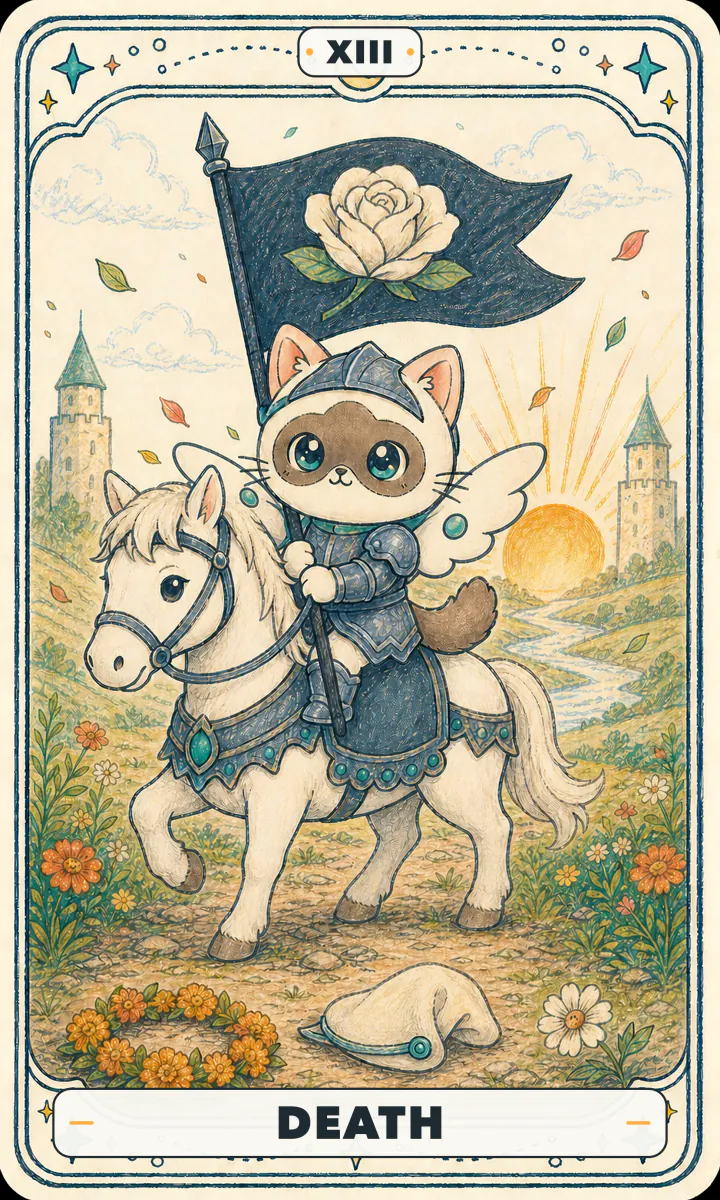
A skeletal knight in black armor rides slowly forward on a white horse, bearing a black banner with a white rose. Beneath the horse's hooves lie a fallen king, a praying bishop, and an innocent child. Twin towers and a rising sun mark the horizon.
Upright meaning
Endings, transformation, rebirth, inevitable change. Symbolizes the complete close of an old chapter, clearing space for something new to grow.
Reversed meaning
Resisting change, stagnation, decay, inability to let go. May indicate clinging to the past, prolonging pain and blocking entry into a new phase.
Love, Career, Money, and Growth
Love
In love, Death points to The complete end of the old. Read it back against how the relationship actually behaves and what you are both choosing.
Career
In career matters, Death points to The complete end of the old. Start by working out which resources you control and what your next move is.
Money
In money matters, Death points to The complete end of the old. Do not treat a symbolic reading as an investment conclusion — go by facts, budget and your own risk tolerance.
Personal growth
For personal growth, Death points to The complete end of the old. Write down the question it raises, then turn that into an action you can actually check.
How they feel
When Death shows how someone feels about you, the theme of their attitude is: The complete end of the old. Upright, that feeling is turned outward and easy to see; reversed, it stays inside them for now. Don't treat it as a verdict: check it against how they actually act.
Yes or No
Upright
No
Reversed
Maybe
This is our own quick read, based on which way the card’s meaning leans. Traditions disagree about individual cards, and a “Maybe” needs to be weighed against the position in the spread and your actual situation rather than taken as a one-word answer.
Waite’s Original Text (1911)
Inner Symbolism (original)
The veil or mask of life is perpetuated in change, transformation and passage from lower to higher, and this is more fitly represented in the rectified Tarot by one of the apocalyptic visions than by the crude notion of the reaping skeleton. Behind it lies the whole world of ascent in the spirit. The mysterious horseman moves slowly, bearing a black banner emblazoned with the Mystic Rose, which signifies life. Between two pillars on the verge of the horizon there shines the sun of immortality. The horseman carries no visible weapon, but king and child and maiden fall before him, while a prelate with clasped hands awaits his end.
There should be no need to point out that the suggestion of death which I have made in connection with the previous card is, of course, to be understood mystically, but this is not the case in the present instance. The natural transit of man to the next stage of his being either is or may be one form of his progress, but the exotic and almost unknown entrance, while still in this life, into the state of mystical death is a change in the form of consciousness and the passage into a state to which ordinary death is neither the path nor gate. The existing occult explanations of the 13th card are, on the whole, better than usual, rebirth, creation, destination, renewal, and the rest.
Original Upright Meaning
End, mortality, destruction, corruption; also, for a man, the loss of a benefactor; for a woman, many contrarieties; for a maid, failure of marriage projects.
Original Reversed Meaning
Inertia, sleep, lethargy, petrifaction, somnambulism; hope destroyed.
Quoted from A. E. Waite, The Pictorial Key to the Tarot (1911), illustrated by Pamela Colman Smith. The text is in the public domain.
Myth and symbol origins
The reaping skeleton is the medieval Danse Macabre scheme; Waite says he replaced it with the rider from Revelation.
Documented imagery
Attested by surviving objects or texts
The Danse Macabre takes everyone alike
The figures fallen in the foreground are a king, a bishop (the cleric waiting with hands joined), a maiden and a child. This is the standard cast of the medieval Danse Macabre and Triumph of Death image traditions: Death leads people of every rank in one dance, pope and beggar in the same line, the point being that rank counts for nothing before it. In Petrarch's Trionfi, Death is likewise the car that conquers Chastity.
Source The medieval Danse Macabre and Triumph of Death image traditions; Petrarch's Trionfi
Esoteric correspondence
A sourced traditional claim, but constructed inside an occult system
Waite replaced the skeleton with a rider
Waite states it plainly: the meaning is, "more fitly represented in the rectified Tarot by one of the apocalyptic visions than by the crude notion of the reaping skeleton." Death on horseback comes from Revelation 6:8. He also writes that the black banner bears the Mystic Rose, which "signifies life," and that between two pillars on the horizon rises "the sun of immortality." Which is to say: the life and the immortality on this card were deliberately put there by the author to hold death down.
Source Revelation 6:8; Waite, The Pictorial Key to the Tarot, 1911, Death
Scorpio and the letter Nun
The Golden Dawn assigns Death to Scorpio (Hebrew letter Nun, which literally means "fish" and is often described as bound up with continuation and generation). What the Scorpio attribution brings is the register of a complete change of form, not of stopping.
Source Golden Dawn Book T zodiacal attributions
Modern reading
Popular only since the twentieth century; unrelated to where the card came from
"Death never means death" — that has been pushed too far
To avoid frightening querents, modern divination says as a matter of course that this card is only about transformation and is never death. Waite's text is finer-grained than that: he says the death mentioned on the previous card "is, of course, to be understood mystically, but this is not the case in the present instance," and distinguishes a person passing naturally into the next stage from entering the mystical death within this life. He also, unusually for him, pays it a compliment: the existing esoteric readings of this card are "on the whole, better than usual," and rebirth, creation and renewal all count. So the accurate statement is this: the weight of the card falls on a complete replacement of form, not on "it has nothing to do with death."
Source The standard modern divinatory disclaimer; the distinction Waite draws in this same entry in 1911
Written by BESTAROT, not quoted from historical sources. Each claim is tagged by how well it is evidenced; modern interpretive layers are useful for reading, but they are not the card’s historical origin.
Study the theme: Myth and Symbol Origins (Academy chapter 6)