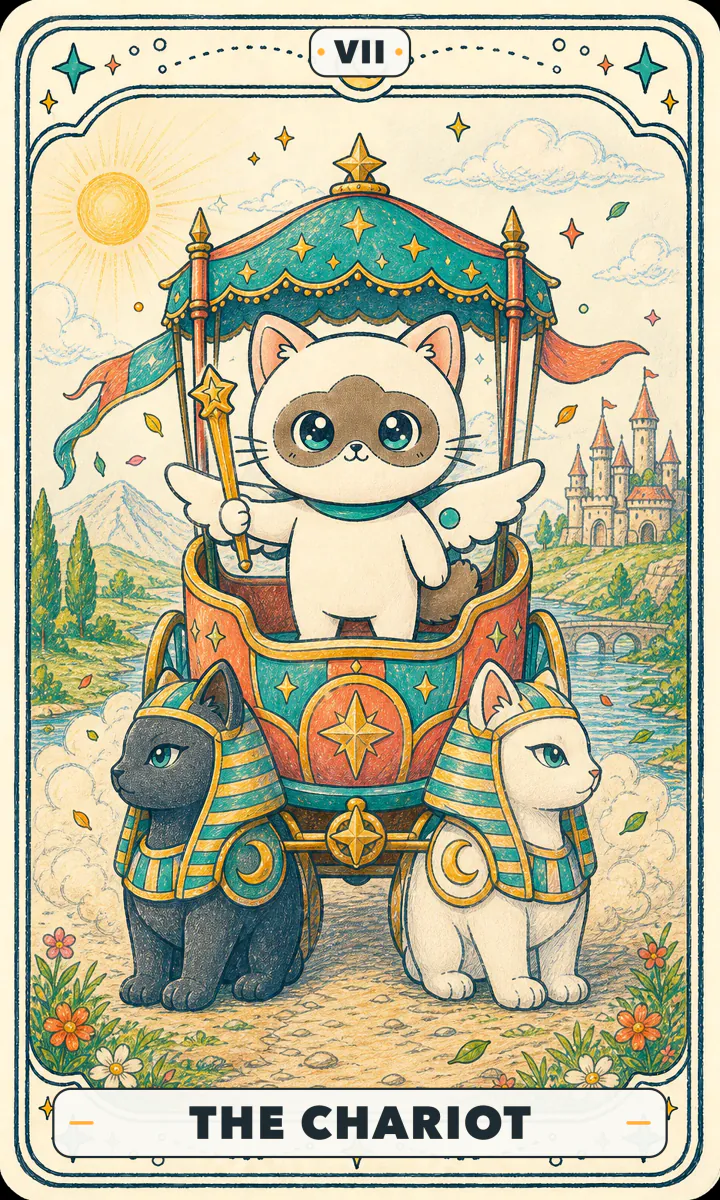
The Chariot
Victory, Control
Quick answer
The core meaning of The Chariot is Willpower overcoming obstacles. Upright, it usually points to Victory, willpower, self-control, determination. Symbolizes uniting opposing for; reversed, it may suggest Loss of control, aggression, defeat, lack of direction. May indicate being torn.
Card imagery
A warrior stands in a chariot beneath a starry canopy, crescent moons on his shoulders. The chariot is drawn by two sphinxes, one black and one white, though no reins are visible. A river and a castle fill the background.
Upright meaning
Victory, willpower, self-control, determination. Symbolizes uniting opposing forces (the black and white sphinxes) through sheer will to overcome obstacles.
Reversed meaning
Loss of control, aggression, defeat, lack of direction. May indicate being torn apart by emotions or conflicting forces, knocking your path off course.
Love, Career, Money, and Growth
Love
In love, The Chariot points to Willpower overcoming obstacles. Read it back against how the relationship actually behaves and what you are both choosing.
Career
In career matters, The Chariot points to Willpower overcoming obstacles. Start by working out which resources you control and what your next move is.
Money
In money matters, The Chariot points to Willpower overcoming obstacles. Do not treat a symbolic reading as an investment conclusion — go by facts, budget and your own risk tolerance.
Personal growth
For personal growth, The Chariot points to Willpower overcoming obstacles. Write down the question it raises, then turn that into an action you can actually check.
How they feel
When The Chariot shows how someone feels about you, the theme of their attitude is: Willpower overcoming obstacles. Upright, that feeling is turned outward and easy to see; reversed, it stays inside them for now. Don't treat it as a verdict: check it against how they actually act.
Yes or No
Upright
Yes
Reversed
No
This is our own quick read, based on which way the card’s meaning leans. Traditions disagree about individual cards, and a “Maybe” needs to be weighed against the position in the spread and your actual situation rather than taken as a one-word answer.
Waite’s Original Text (1911)
Inner Symbolism (original)
An erect and princely figure carrying a drawn sword and corresponding, broadly speaking, to the traditional description which I have given in the first part. On the shoulders of the victorious hero are supposed to be the Urim and Thummim. He has led captivity captive; he is conquest on all planes—in the mind, in science, in progress, in certain trials of initiation. He has thus replied to the Sphinx, and it is on this account that I have accepted the variation of Eliphas Lévi; two sphinxes thus draw his chariot. He is above all things triumph in the mind.
It is to be understood for this reason (a) that the question of the sphinx is concerned with a Mystery of Nature and not of the world of Grace, to which the charioteer could offer no answer; (b) that the planes of his conquest are manifest or external and not within himself; (c) that the liberation which he effects may leave himself in the bondage of the logical understanding; (d) that the tests of initiation through which he has passed in triumph are to be understood physically or rationally and (e) that if he came to the pillars of that Temple between which the High Priestess is seated, he could not open the scroll called Tora, nor if she questioned him could he answer. He is not hereditary royalty and he is not priesthood.
Original Upright Meaning
Succor, providence; also war, triumph, presumption, vengeance, trouble.
Original Reversed Meaning
Riot, quarrel, dispute, litigation, defeat.
Quoted from A. E. Waite, The Pictorial Key to the Tarot (1911), illustrated by Pamela Colman Smith. The text is in the public domain.
Myth and symbol origins
Triumph is the deck's own original name. The sphinxes are Lévi's substitution, and Plato's chariot was attached by later hands.
Documented imagery
Attested by surviving objects or texts
This card is where the whole deck got its name
The oldest name for the trumps is trionfi — triumphs. The image tradition is the Roman triumphal procession, and Petrarch's Trionfi, with its file of triumphal cars each conquering the one before it: Love conquers man, Chastity conquers Love, Death conquers Chastity, Fame conquers Death, Time conquers Fame, Eternity conquers Time. The whole run of trumps is that same procession of "the next one beats the last one," and the Chariot is the card that draws the motif most plainly.
Source The trumps' original name trionfi; the image tradition of Petrarch's Trionfi (I Trionfi, fourteenth century)
Esoteric correspondence
A sourced traditional claim, but constructed inside an occult system
Two sphinxes, and a riddle already answered
Older decks had two horses drawing the car. Waite states that he has "accepted the variation of Eliphas Lévi" and put two sphinxes there instead, and writes that the charioteer "replied to the Sphinx" — an allusion to Oedipus solving the riddle. He then discounts that victory in the same breath: the riddle of the sphinx belongs to "a Mystery of Nature," and should the charioteer come to the two pillars where the High Priestess sits, "he could not open the scroll called Tora."
Source Waite, The Pictorial Key to the Tarot, 1911, The Chariot; Eliphas Lévi's reconstruction of the card
The Urim and Thummim on his shoulders
Waite writes that the charioteer carries Urim and Thummim on his shoulders — the objects on the breastplate of the Hebrew high priest used to inquire of God (Exodus 28:30). On the card the shoulder-pieces are drawn as two moon-like faces. Once again: a Greek sphinx and a Hebrew priestly implement, side by side on the same card.
Source Exodus 28:30; Waite, The Pictorial Key to the Tarot, 1911, The Chariot
Cancer: advancing inside a shell
The Golden Dawn assigns the Chariot to Cancer (Hebrew letter Cheth). The car is a hard shell, and the figure inside it is both protected and confined — which explains why the victory on this card always tastes of being held together by will, rather than of winning easily.
Source Golden Dawn Book T zodiacal attributions
Modern reading
Popular only since the twentieth century; unrelated to where the card came from
Plato's chariot of the soul: a fine fit, but fitted afterwards
The passage most often quoted about this card is Plato's Phaedrus: the soul as a charioteer driving two horses, one black and one white, one pulling up and one pulling down, the driver's task being to get them going the same way. The black and white sphinxes on the card answer to it beautifully — but those sphinxes were put there by Lévi in the 1850s, and there is no line of descent between Plato's image and the fifteenth-century triumphal car. It works well as a tool for understanding the card. As a source it is simply wrong.
Source Modern popular reading; the chariot of the soul is in Plato's Phaedrus 246a–254e
Written by BESTAROT, not quoted from historical sources. Each claim is tagged by how well it is evidenced; modern interpretive layers are useful for reading, but they are not the card’s historical origin.
Study the theme: Myth and Symbol Origins (Academy chapter 6)