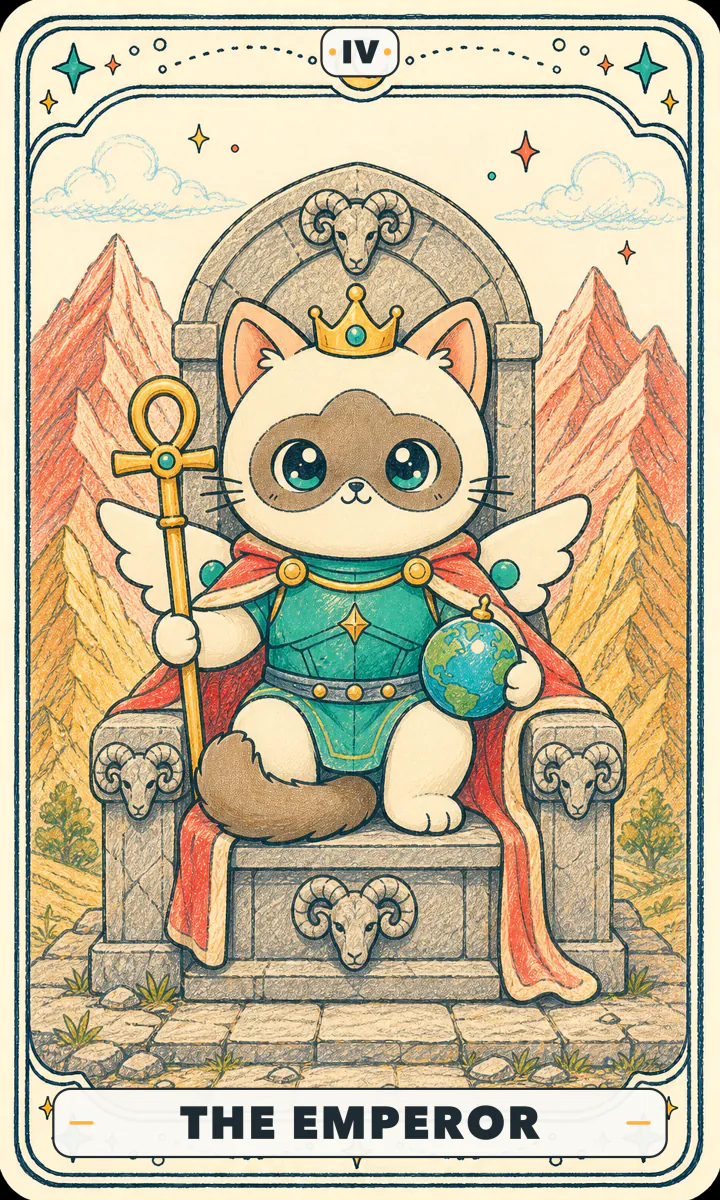
The Emperor
Authority, Structure
Quick answer
The core meaning of The Emperor is Establishing order and rules. Upright, it usually points to Authority, structure, the father figure, logic, rules. Symbolizes building order; reversed, it may suggest Tyranny, rigidity, lack of discipline, abuse of power. May indicate an overbeari.
Card imagery
A stately elder sits upon a stone throne adorned with rams' heads, against a backdrop of red skies and barren mountains. He wears armor beneath a red robe and holds a scepter and an orb, symbols of power.
Upright meaning
Authority, structure, the father figure, logic, rules. Symbolizes building order and solid foundations, achieving success through discipline and leadership.
Reversed meaning
Tyranny, rigidity, lack of discipline, abuse of power. May indicate an overbearing need for control, or conversely, weakness and a complete lack of resolve.
Love, Career, Money, and Growth
Love
In love, The Emperor points to Establishing order and rules. Read it back against how the relationship actually behaves and what you are both choosing.
Career
In career matters, The Emperor points to Establishing order and rules. Start by working out which resources you control and what your next move is.
Money
In money matters, The Emperor points to Establishing order and rules. Do not treat a symbolic reading as an investment conclusion — go by facts, budget and your own risk tolerance.
Personal growth
For personal growth, The Emperor points to Establishing order and rules. Write down the question it raises, then turn that into an action you can actually check.
How they feel
When The Emperor shows how someone feels about you, the theme of their attitude is: Establishing order and rules. Upright, that feeling is turned outward and easy to see; reversed, it stays inside them for now. Don't treat it as a verdict: check it against how they actually act.
Yes or No
Upright
Yes
Reversed
No
This is our own quick read, based on which way the card’s meaning leans. Traditions disagree about individual cards, and a “Maybe” needs to be weighed against the position in the spread and your actual situation rather than taken as a one-word answer.
Waite’s Original Text (1911)
Inner Symbolism (original)
He has a form of the Crux ansata for his scepter and a globe in his left hand. He is crowned monarch—commanding, stately, seated on a throne, the arms of which are fronted by rams' heads. He is executive and realization, the power of this world, here clothed with the highest of its natural attributes. He is occasionally represented as seated on a cubic stone, which, however, confuses some of the issues. He is the virile power, to which the Empress responds, and in this sense is he who seeks to remove the Veil of Isis; yet she remains virgo intacta.
It should be understood that this card and that of the Empress do not precisely represent the condition of married life, though this state is implied. On the surface, as I have indicated, they stand for mundane royalty, uplifted on the seats of the mighty; but above this there is the suggestion of another presence. They signify, also—and the male figure especially—the higher kingship, occupying the intellectual throne. Hereof is the lordship of thought rather than of the animal world. Both personalities, after their own manner, are "full of strange experience," but theirs is not consciously the wisdom which draws from a higher world. The Emperor has been described as (a) will in its embodied form, but this is only one of its applications, and (b) as an expression of virtualities contained in the Absolute Being—but this is fantasy.
Original Upright Meaning
Stability, power, protection, realization; a great person; aid, reason, conviction; also authority and will.
Original Reversed Meaning
Benevolence, compassion, credit; also confusion to enemies, obstruction, immaturity.
Quoted from A. E. Waite, The Pictorial Key to the Tarot (1911), illustrated by Pamela Colman Smith. The text is in the public domain.
Myth and symbol origins
The rams' heads on the throne are Aries; the sceptre in his hand is an Egyptian ankh. The nineteenth-century taste for Egypt stayed on the card.
Documented imagery
Attested by surviving objects or texts
He and the Empress are a pair, but not a marriage
In the early decks the Emperor and Empress are a paired image of secular office. Waite goes out of his way to note that the two cards "do not precisely represent the condition of married life, though this state is included therein"; they are rather the higher kingship on the intellectual throne. Reading the pair straight off as parents or as husband and wife takes a Renaissance diagram of office for a diagram of the family.
Source The paired sovereign images of early Italian tarot; Waite, The Pictorial Key to the Tarot, 1911, The Emperor
Esoteric correspondence
A sourced traditional claim, but constructed inside an occult system
Rams' heads mean Aries
Waite states that the arms of the throne are fronted by rams' heads. The ram is the sign of Aries, and the Golden Dawn attribution for the Emperor is indeed Aries (Hebrew letter Heh); the ruler of Aries is Mars — Roman Mars, counterpart of Greek Ares. The whole register of initiating, issuing orders and imposing order by force follows down this chain.
Source Waite, The Pictorial Key to the Tarot, 1911, The Emperor; Golden Dawn Book T zodiacal attributions
The ankh and "he who seeks to remove the Veil of Isis"
The sceptre in his hand Waite calls a Crux ansata — the cross with a handle, which is to say the Egyptian ankh, the sign of life. In the same paragraph he writes that the Emperor is "he who seeks to remove the Veil of Isis; yet she remains virgo intacta." Both are traces of the nineteenth-century occult taste for Egypt: Egyptian signs borrowed as a general vocabulary of symbols, not a claim that this card came from Egypt — Waite states that distinction very plainly in the Wheel of Fortune entry.
Source Waite, The Pictorial Key to the Tarot, 1911, The Emperor; the ankh is the Egyptian sign of life
Modern reading
Popular only since the twentieth century; unrelated to where the card came from
The father archetype arrives after Jung
Reading the Emperor as the father archetype, as patriarchy, uses the vocabulary of twentieth-century depth psychology. The reading works well in practice, and it does connect to an office that lays down rules. But archetypal psychology is a Jungian construction, and has nothing to do with the people who painted this card in the fifteenth century.
Source Modern popular reading; the concept of the archetype comes from Jungian writing
Written by BESTAROT, not quoted from historical sources. Each claim is tagged by how well it is evidenced; modern interpretive layers are useful for reading, but they are not the card’s historical origin.
Study the theme: Myth and Symbol Origins (Academy chapter 6)