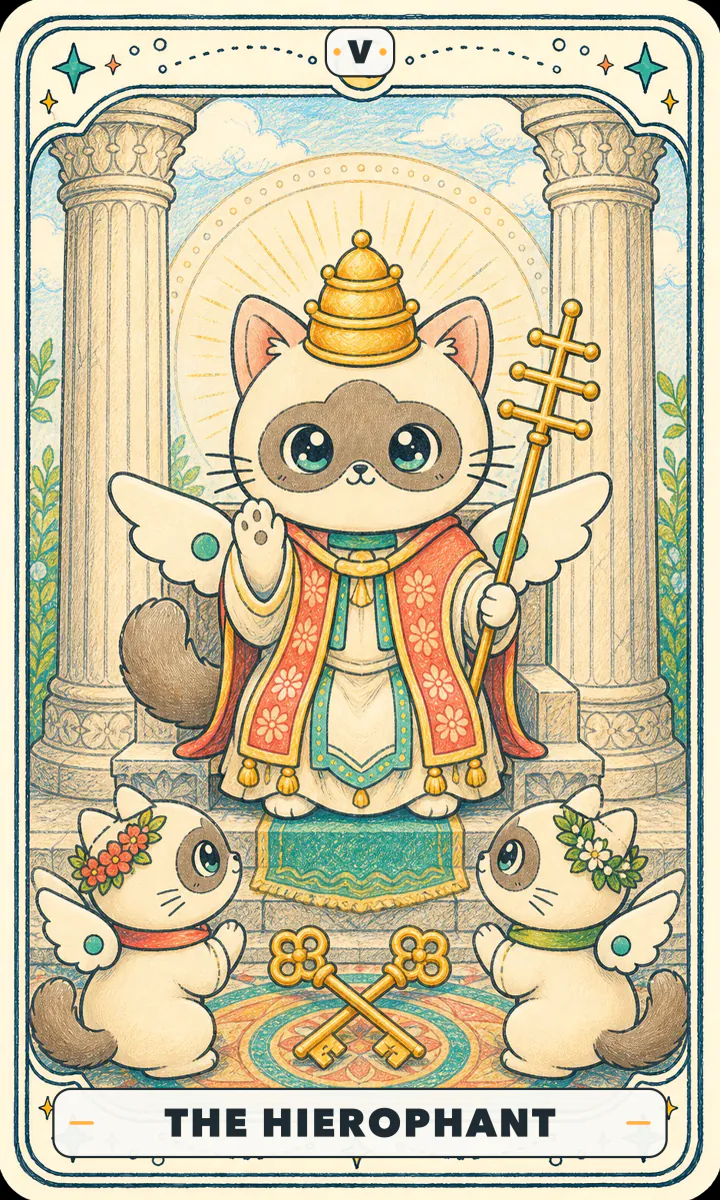
The Hierophant
Tradition, Faith
Quick answer
The core meaning of The Hierophant is Spiritual guidance. Upright, it usually points to Tradition, faith, education, spiritual guidance, belonging. Symbolizes following; reversed, it may suggest Challenging tradition, unconventional beliefs, hypocritical advice, rebellion. M.
Card imagery
The Hierophant, robed in three vestments, sits between two stone pillars wearing a triple crown. His left hand holds a triple-cross staff, his right is raised in blessing. Two crossed keys lie at his feet, and two acolytes kneel before him.
Upright meaning
Tradition, faith, education, spiritual guidance, belonging. Symbolizes following established social conventions or seeking the help of traditional wisdom.
Reversed meaning
Challenging tradition, unconventional beliefs, hypocritical advice, rebellion. May indicate breaking with convention, or feeling constrained by dogma.
Love, Career, Money, and Growth
Love
In love, The Hierophant points to Spiritual guidance. Read it back against how the relationship actually behaves and what you are both choosing.
Career
In career matters, The Hierophant points to Spiritual guidance. Start by working out which resources you control and what your next move is.
Money
In money matters, The Hierophant points to Spiritual guidance. Do not treat a symbolic reading as an investment conclusion — go by facts, budget and your own risk tolerance.
Personal growth
For personal growth, The Hierophant points to Spiritual guidance. Write down the question it raises, then turn that into an action you can actually check.
How they feel
When The Hierophant shows how someone feels about you, the theme of their attitude is: Spiritual guidance. Upright, that feeling is turned outward and easy to see; reversed, it stays inside them for now. Don't treat it as a verdict: check it against how they actually act.
Yes or No
Upright
Yes
Reversed
Maybe
This is our own quick read, based on which way the card’s meaning leans. Traditions disagree about individual cards, and a “Maybe” needs to be weighed against the position in the spread and your actual situation rather than taken as a one-word answer.
Waite’s Original Text (1911)
Inner Symbolism (original)
He wears the triple crown and is seated between two pillars, but they are not those of the Temple which is guarded by the High Priestess. In his left hand he holds a scepter terminating in the triple cross, and with his right hand he gives the well-known ecclesiastical sign which is called that of esotericism, distinguishing between the manifest and concealed part of doctrine. It is noticeable in this connection that the High Priestess makes no sign. At his feet are the crossed keys, and two priestly ministers in albs kneel before him. He has been usually called the Pope, which is a particular application of the more general office that he symbolizes. He is the ruling power of external religion, as the High Priestess is the prevailing genius of the esoteric, withdrawn power. The proper meanings of this card have suffered woeful admixture from nearly all hands. Grand Orient says truly that the Hierophant is the power of the keys, exoteric orthodox doctrine, and the outer side of the life which leads to the doctrine; but he is certainly not the prince of occult doctrine, as another commentator has suggested.
He is rather the summa totius theologiæ, when it has passed into the utmost rigidity of expression; but he symbolizes also all things that are righteous and sacred on the manifest side. As such, he is the channel of grace belonging to the world of institution as distinct from that of Nature, and he is the leader of salvation for the human race at large. He is the order and the head of the recognized hierarchy, which is the reflection of another and greater hierarchic order; but it may so happen that the pontiff forgets the significance of this his symbolic state and acts as if he contained within his proper measures all that his sign signifies or his symbol seeks to show forth. He is not, as it has been thought, philosophy—except on the theological side; he is not inspiration; and he is not religion, although he is a mode of its expression.
Original Upright Meaning
Marriage, alliance, captivity, servitude; by another account, mercy and goodness; inspiration; the man to whom the Querent has recourse.
Original Reversed Meaning
Society, good understanding, concord, over-kindness, weakness.
Quoted from A. E. Waite, The Pictorial Key to the Tarot (1911), illustrated by Pamela Colman Smith. The text is in the public domain.
Myth and symbol origins
The picture is a pope; the name is the title of the presiding priest of the Greek Eleusinian Mysteries. It was Waite who changed it.
Documented imagery
Attested by surviving objects or texts
The picture is simply a pope
In early Italian decks this card is Il Papa, the Pope, paired with the Popess. Every element on the card is standard Catholic institutional equipment: the triple crown, the triple cross sceptre, the crossed keys at his feet — and the keys come from Matthew 16:19, the keys of the kingdom of heaven given to Peter. Waite writes it himself: he has usually been called the Pope.
Source The early Italian card name Il Papa; Matthew 16:19 (the keys of the kingdom); Waite 1911
The word Hierophant is Greek
Renaming the Pope as the Hierophant was the practice of Waite's generation. The word is Greek, ἱεροφάντης, literally "one who shows sacred things," and it was the formal title of the presiding priest of the Eleusinian Mysteries — whose central myth is that of Demeter and Persephone. So there is a genuine Greek thread on this card. It is just not in the image; it is in the name, and it was attached only at the end of the nineteenth century.
Source ἱεροφάντης is the title of the presiding priest at Eleusis; the renaming is in Waite 1911
Esoteric correspondence
A sourced traditional claim, but constructed inside an occult system
Taurus and the weight of the institution
The Golden Dawn assigns the Hierophant to Taurus (Hebrew letter Vau). The register of stability, of bearing weight, of moving slowly and not changing comes from there, and it sits well with a card defined as the ruling power of established religion.
Source Golden Dawn Book T zodiacal attributions
Modern reading
Popular only since the twentieth century; unrelated to where the card came from
Reading him as a spiritual teacher runs backwards
The contemporary habit is to read this card as the guru, the spiritual teacher, inner authority. Waite's text defines it as precisely the opposite: the Hierophant is "the ruling power of external religion," set against the esoteric, withdrawn power the High Priestess stands for, and he explicitly denies the claim that he is the prince of occult doctrine. Which is to say: this card governs institutions, public doctrine and procedure, not a private spiritual guide.
Source Modern popular reading; Waite 1911 denies the "prince of occult doctrine" reading in this same entry
Written by BESTAROT, not quoted from historical sources. Each claim is tagged by how well it is evidenced; modern interpretive layers are useful for reading, but they are not the card’s historical origin.
Study the theme: Myth and Symbol Origins (Academy chapter 6)